
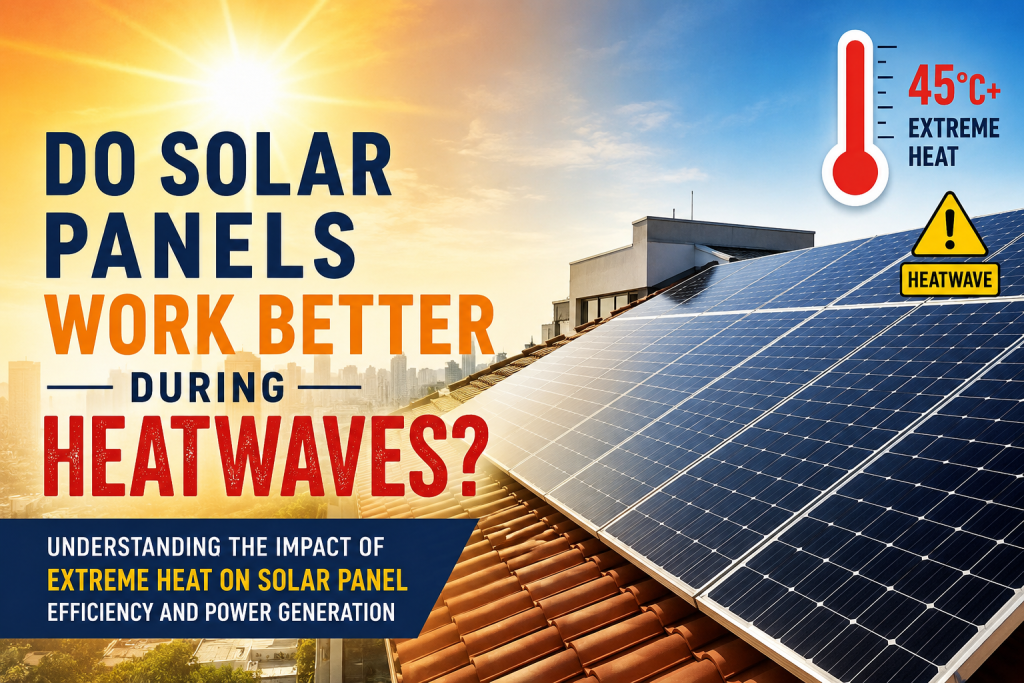
Heatwaves are becoming increasingly frequent and intense across India. Extremely high summer temperatures place significant pressure on electricity demand across homes, businesses, and industries.
A heatwave is a prolonged period of unusually high temperatures, often accompanied by dry weather conditions. In recent years, rising global temperatures and changing climate patterns have contributed to more severe and longer-lasting heatwaves throughout the country.
At the same time, solar energy adoption is growing rapidly. Rooftop solar systems are now commonly installed on residential buildings, commercial establishments, factories, warehouses, and educational institutions.
This raises an important question:
Do solar panels perform better during heatwaves because of stronger sunlight, or does excessive heat reduce their efficiency?
The answer is both.
Longer summer days and clear skies can increase solar energy generation, but extremely high temperatures can reduce panel efficiency and place additional stress on solar system components.
Do Solar Panels Generate More Electricity During Summer?
In general, solar panels produce more electricity during summer because sunlight remains available for longer hours and is often more intense.
Summer Conditions That Support Solar Generation
| Factor | Impact on Solar Panels |
|---|---|
| Strong sunlight | Increases electricity generation |
| Longer daylight hours | Extends production time |
| Clear skies | Supports stable solar output |
| Reduced cloud cover | Improves sunlight absorption |
This is why solar systems often generate more total energy during summer compared to monsoon or winter seasons.
However, sunlight and heat are not the same thing.
Solar panels require sunlight to generate electricity, but excessive temperatures can reduce their operating efficiency.
How Extreme Heat Affects Solar Panel Efficiency
Solar panels generate electricity using semiconductor materials. As panel temperatures rise beyond their optimal operating range, electrical resistance within the cells increases.
This leads to a gradual reduction in voltage output and overall efficiency.
Most solar panels are tested under standard conditions of 25°C. For every degree above this temperature, panel efficiency typically decreases by approximately 0.3% to 0.5%, depending on the panel technology.
| Panel Temperature | Performance Impact |
| 25°C | Ideal operating condition |
| 35°C | Minor efficiency reduction |
| 45°C | Noticeable performance drop |
| 55°C+ | Significant heat stress |
Although solar panels continue generating electricity during heatwaves, they may not operate at their maximum efficiency.
Effects of Heatwaves on Solar Infrastructure
Heatwaves impact more than just solar panels. Other components within a solar power system can also experience thermal stress.
| Solar Component | Heatwave Impact |
| Solar panels | Reduced efficiency |
| Inverters | Higher operating temperatures |
| Batteries | Faster degradation |
| Electrical wiring | Increased thermal stress |
Heat Stress on Solar Panels
Solar panels expand during the day as temperatures rise and contract when temperatures fall at night. Over time, repeated thermal expansion and contraction can create microscopic cracks within the panel structure, potentially affecting long-term performance.
Inverter Heating Issues
Inverters convert DC electricity generated by solar panels into usable AC electricity. During heatwaves, inverters may operate at elevated internal temperatures, especially if installed in poorly ventilated areas.
Battery Performance During Summer
Battery storage systems are sensitive to high temperatures. Prolonged heat exposure can accelerate battery degradation, reduce storage capacity, and shorten overall lifespan.
Dust and Pollution Further Reduce Solar Output
Heatwaves are often accompanied by dry winds, dust accumulation, and increased air pollution.
| Summer Condition | Effect on Solar Systems |
| Dust accumulation | Reduces sunlight absorption |
| Dry winds | Increase dirt buildup |
| Pollution layers | Lower energy generation |
| Lack of cleaning | Gradual decline in output |
Regular cleaning and maintenance help maintain optimal performance, especially during peak summer months.
Why Solar Energy Remains Valuable During Heatwaves
Despite some efficiency losses caused by extreme heat, solar energy continues to provide substantial benefits during summer.
Rising Electricity Demand
Heatwaves significantly increase electricity consumption due to:
- Continuous air-conditioner usage
- Increased fan operation
- Greater refrigeration demand
- Commercial cooling requirements
Most of this demand occurs during daylight hours, which closely aligns with peak solar energy generation.
Reducing Pressure on the Grid
Solar energy helps meet daytime demand without additional fuel consumption, reducing pressure on conventional power plants and electricity distribution networks.
Support During Power Outages
Homes and businesses equipped with battery-backed solar systems can continue operating essential appliances during power cuts, making solar energy a reliable source of backup power.
New Solar Technologies Are Improving Heat Performance
Modern solar technologies are becoming more efficient in hot weather conditions.
| Solar Panel Type | Typical Temperature Coefficient |
| Monocrystalline | -0.3% to -0.4% per °C |
| Polycrystalline | -0.4% to -0.5% per °C |
| Thin-film | Better heat tolerance in some conditions |
Panels with lower temperature coefficients experience smaller efficiency losses as temperatures rise.
Proper installation design, ventilation, and real-time monitoring systems can further improve solar performance during heatwaves.
How to Improve Solar Performance During Summer
To maximize solar efficiency during hot weather:
- Clean solar panels regularly.
- Ensure proper airflow beneath rooftop installations.
- Install inverters in shaded and ventilated locations.
- Choose panels with lower temperature coefficients.
- Use monitoring systems to track performance.
The Future of Solar Energy in India
India’s solar sector continues to expand rapidly across residential, commercial, and industrial markets.
Although extreme temperatures can slightly reduce solar panel efficiency, solar power remains one of the most effective solutions for meeting rising daytime electricity demand.
Future innovations in solar cells, battery storage, cooling systems, and smart energy management technologies are expected to further improve solar performance in hot climates.
Conclusion
Heatwaves create both opportunities and challenges for solar energy systems.
Longer daylight hours and strong sunlight help increase electricity generation, while excessive temperatures can reduce panel efficiency and place stress on solar infrastructure.
Despite these limitations, solar energy remains a reliable, sustainable, and cost-effective solution for meeting growing electricity needs during extreme summer conditions.
Frequently Asked Questions (FAQs)
1. Do solar panels work during heatwaves?
Yes. Solar panels continue generating electricity during heatwaves because sunlight remains abundant. However, extremely high temperatures can slightly reduce their efficiency.
2. Does hot weather increase solar panel output?
Hot weather itself does not improve performance. Strong sunlight increases electricity generation, but excessive heat can reduce panel efficiency.
3. How much efficiency do solar panels lose in high temperatures?
Most solar panels lose approximately 0.3% to 0.5% efficiency for every degree Celsius above their standard testing temperature of 25°C.
4. Which solar panel type performs best in hot climates?
Monocrystalline solar panels generally perform better in high temperatures because they typically have lower temperature coefficients than polycrystalline panels.
5. Can heatwaves damage solar panels?
Heatwaves usually do not damage quality solar panels directly. However, prolonged exposure to extreme temperatures can contribute to long-term wear and thermal stress.
6. How can I improve solar panel performance during summer?
Regular cleaning, proper ventilation, shaded inverter placement, and routine monitoring can help maintain optimal solar system performance during hot weather.
7. Do solar batteries get affected by high temperatures?
Yes. High temperatures can accelerate battery degradation and reduce the lifespan of solar storage systems if they are not properly cooled and maintained.
8. Is solar energy still worth installing in regions with extreme heat?
Absolutely. Even though efficiency may decrease slightly during peak temperatures, solar systems continue generating significant electricity and help reduce energy costs and dependence on the grid.
9. Why do solar panels need sunlight instead of heat?
Solar panels generate electricity from sunlight using photovoltaic cells. Heat is not required for power generation and can actually reduce panel efficiency when temperatures become too high.
10. What is the ideal temperature for solar panel operation?
Most solar panels are tested under standard conditions of 25°C, which is considered the ideal operating temperature for maximum efficiency.