Clean Solar Panels the Right Way to Maximize Efficiency and Extend Their Lifespan
Rooftop solar panels are one of the smartest investments for Indian homeowners. They help reduce electricity bills, lower dependence on grid power, and contribute to a cleaner environment. However, many people overlook one critical aspect of solar ownership—regular solar panel cleaning.
Dust, pollution, bird droppings, leaves, and other debris gradually accumulate on the surface of solar panels. This layer blocks sunlight from reaching the photovoltaic cells, reducing the system’s ability to generate electricity efficiently. In countries like India, where dust levels are often high, neglected solar panels can lose a significant portion of their energy output over time.
Studies have shown that poorly maintained solar panels can produce considerably less electricity compared to clean panels. Besides lowering energy generation, improper cleaning methods may also damage the protective glass coating and, in some cases, affect the manufacturer’s warranty.
Whether you have a 3 kW, 5 kW, or 10 kW rooftop solar system, understanding how to clean solar panels correctly is essential for maintaining maximum performance throughout the system’s lifespan.
In this comprehensive guide, you’ll learn:
- Why solar panel cleaning is important
- The safest way to clean rooftop solar panels
- DIY cleaning methods
- Mistakes to avoid
- Recommended cleaning frequency
- Professional maintenance vs DIY cleaning
- Tips to improve long-term solar performance
Quick Summary: Best Way to Clean Solar Panels
If you’re looking for the shortest answer, here it is.
The safest method to clean solar panels is:
✔ Switch off the solar system before cleaning.
✔ Clean panels early in the morning or late in the evening.
✔ Use soft water (RO or low-mineral water).
✔ Rinse gently using low water pressure.
✔ Remove dirt with a soft microfiber cloth or nylon-bristle brush.
✔ Use only mild, non-abrasive cleaning solutions.
✔ Dry the panels with a soft rubber squeegee.
Avoid:
- Pressure washers
- Hard water
- Metal brushes
- Abrasive scrubbers
- Harsh chemicals
- Walking directly on the panels
- Cleaning hot panels under direct sunlight
For maximum safety and warranty protection, professional cleaning through an Annual Maintenance Contract (AMC) is always recommended.
Why Is Solar Panel Cleaning Important?
Solar panels work by converting sunlight into electricity. For maximum energy generation, sunlight must directly reach the solar cells beneath the protective glass surface.
When dust, bird droppings, pollen, pollution, tree sap, or leaves accumulate on the panel surface, they block sunlight and reduce electricity production.
Even a thin layer of dirt can affect performance over time.
Regular cleaning ensures that your rooftop solar system continues operating at peak efficiency throughout the year.
7 Reasons Why Cleaning Solar Panels Matters
1. Improves Power Generation
The primary reason to clean solar panels is improved electricity production.
Dirty panels absorb less sunlight, which directly reduces energy generation.
When panels remain clean, they capture maximum solar radiation and produce more electricity throughout the day.
Higher generation means:
- Lower electricity bills
- Better return on investment
- Faster recovery of installation cost
2. Prevents Energy Loss
India experiences heavy dust, vehicle pollution, construction debris, and seasonal pollen.
Without regular cleaning, these contaminants gradually cover the panel surface.
This can reduce system efficiency considerably over time.
Regular maintenance keeps the glass surface clear, allowing sunlight to pass through without obstruction.
3. Extends Solar Panel Life
Solar panels are designed to last more than 25 years.
However, poor maintenance may shorten their effective lifespan.
Bird droppings, accumulated dirt, moisture retention, and chemical deposits can slowly damage the protective coating if ignored for extended periods.
Routine cleaning helps maintain both the appearance and durability of the system.
4. Protects Manufacturer Warranty
Many homeowners don’t realize that manufacturers often include maintenance requirements in their warranty conditions.
Using incorrect cleaning methods may result in:
- Scratched glass
- Damaged anti-reflective coating
- Broken seals
- Microcracks
- Corrosion
Any physical damage caused by improper cleaning may not be covered under warranty.
Following manufacturer-approved cleaning practices helps protect your investment.
5. Reduces Hot Spot Formation
One overlooked issue with dirty panels is the development of hot spots.
When certain sections of a solar panel remain covered by dirt while the surrounding cells receive full sunlight, those shaded cells can heat up excessively.
Over time, hot spots may:
- Reduce panel efficiency
- Damage solar cells
- Stress electrical connections
- Increase maintenance costs
Uniform cleaning minimizes this risk.
6. Maximizes Return on Investment
Installing rooftop solar is a long-term investment.
Every additional unit of electricity generated contributes to greater savings.
Clean panels generate more electricity, helping homeowners recover their installation cost faster while maximizing savings over the system’s lifetime.
7. Maintains Overall System Health
Solar panels are only one component of your rooftop solar system.
Regular inspections during cleaning also help identify issues such as:
- Loose wiring
- Damaged mounting structures
- Bird nests
- Cracked glass
- Water leakage
- Shaded areas
- Corroded connectors
Detecting these problems early helps avoid expensive repairs later.
What Causes Solar Panels to Become Dirty?
Several environmental factors contribute to dirt accumulation on rooftop solar panels.
Dust
Dust is the biggest challenge for solar installations across India.
Cities with ongoing construction, dry weather, or nearby roads experience faster dust accumulation.
Bird Droppings
Bird droppings create stubborn stains that block sunlight and are difficult to remove without proper cleaning techniques.
Tree Leaves
Nearby trees may shed leaves, flowers, pollen, and sticky sap that collect on the panel surface.
Air Pollution
Industrial smoke, vehicle emissions, and urban pollution leave a thin layer of grime on solar panels.
Rainwater Residue
Although rainfall removes loose dust, it often leaves behind mineral deposits and water spots, especially in areas with hard water.
Post-monsoon cleaning is still recommended.
Construction Debris
If construction work is happening nearby, cement dust and fine particles can quickly reduce solar panel efficiency.
Signs Your Solar Panels Need Cleaning
You don’t always need professional monitoring equipment to know your panels require cleaning.
Watch for these common signs:
- Noticeable dust covering the glass
- Bird droppings on multiple panels
- Leaves or branches blocking sunlight
- Reduced electricity generation
- Higher electricity bills despite similar usage
- Water stains after rainfall
- Visible dirt accumulation around panel edges
If any of these signs appear, it’s time to clean your rooftop solar panels.
How Much Efficiency Can Dirty Solar Panels Lose?
The exact reduction depends on several factors, including:
- Location
- Dust levels
- Air pollution
- Bird activity
- Tree cover
- Weather conditions
- Cleaning frequency
In highly polluted or dusty environments, neglected panels may experience substantial performance losses over time. Even moderate dirt buildup can noticeably reduce daily energy production, making regular cleaning an important part of solar system maintenance.
How to Clean Solar Panels Safely
Cleaning solar panels is not complicated, but it requires the right techniques. Using incorrect tools or cleaning methods can scratch the tempered glass, damage the anti-reflective coating, reduce efficiency, and even void the manufacturer’s warranty.
Follow these simple steps to clean your rooftop solar panels safely.
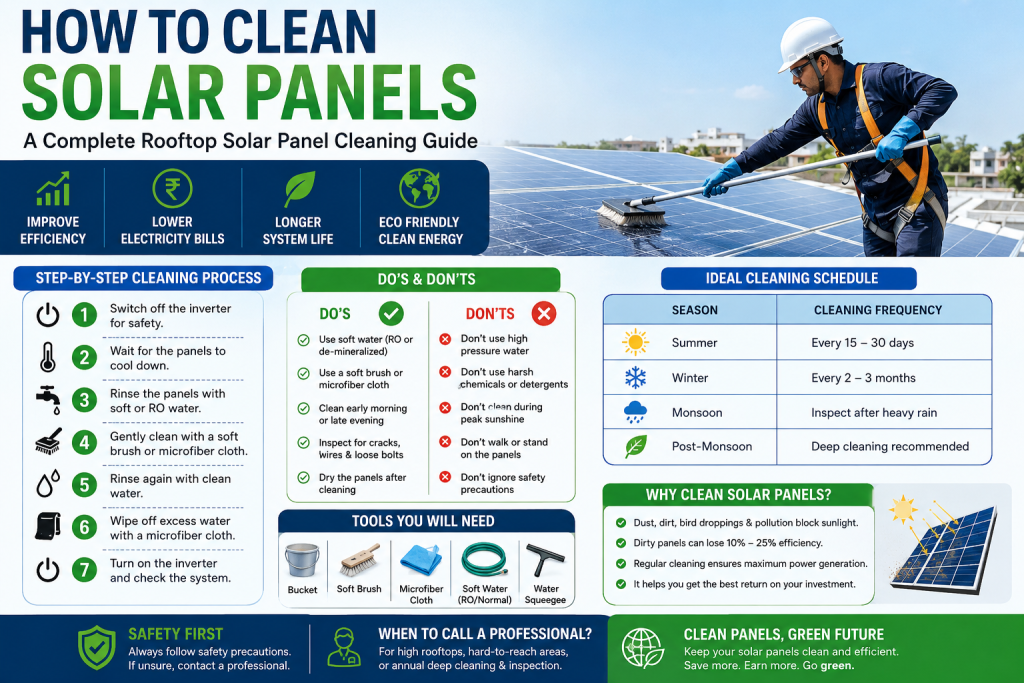
Step 1: Turn Off the Solar Power System
Before you begin cleaning, always switch off your rooftop solar system.
This is the most important safety step.
Although solar panels generate electricity whenever sunlight falls on them, shutting down the inverter and following the manufacturer’s shutdown procedure minimizes electrical risks during cleaning.
Never attempt to clean exposed electrical wiring or connectors.
Safety Tip
- Switch OFF the inverter.
- Follow the shutdown procedure recommended by your installer.
- Never spray water directly on electrical components.
Step 2: Choose the Right Time of Day
Timing plays a crucial role in safe solar panel cleaning.
The best time to clean solar panels is:
- Early morning
- Late evening
- Cloudy weather
Avoid cleaning panels during the hottest part of the day.
When cold water comes into contact with hot solar panels, rapid temperature changes may stress the glass and reduce its lifespan over time.
Morning cleaning is ideal because:
- Panels are cool.
- Dirt is easier to remove.
- Water evaporates slowly.
- There is less risk of streaks.
Step 3: Inspect the Solar Panels
Before using water, inspect the panels carefully.
Look for:
- Bird droppings
- Thick dust deposits
- Leaves
- Twigs
- Broken glass
- Loose wiring
- Animal nests
- Cracked mounting structures
If you notice any damaged components, avoid cleaning until they are inspected by a qualified technician.
Step 4: Remove Loose Dirt
Never begin by scrubbing the panel surface.
Instead, remove loose debris first.
Use:
- Soft microfiber cloth
- Soft nylon brush
- Leaf blower (optional)
This prevents dust particles from scratching the glass during cleaning.
Avoid:
- Steel brushes
- Hard plastic brushes
- Wire scrubbers
- Kitchen scouring pads
Step 5: Rinse Using Clean Water
After removing loose dirt, rinse the panels gently.
The best water options are:
- RO water
- De-ionized water
- Soft water
- Low-mineral water
These water types reduce mineral deposits and help maintain the clarity of the glass surface.
Use only low water pressure.
A gentle garden hose is usually sufficient.
Never use:
- Pressure washers
- Industrial water jets
- High-pressure pumps
Excessive pressure can damage panel seals and frames.
Step 6: Clean Stubborn Dirt Carefully
Sometimes bird droppings or sticky dust cannot be removed with water alone.
Use:
- Mild pH-neutral detergent
- Solar panel cleaning solution
- Soft sponge
- Soft nylon-bristle brush
Clean using gentle circular movements.
Never apply excessive force.
Allow stubborn dirt to soak for a few minutes before wiping it away.
Step 7: Rinse Again
Once cleaning is complete, rinse the panels thoroughly.
Any soap residue left behind can attract more dust and reduce sunlight absorption.
A complete rinse leaves the glass clean and streak-free.
Step 8: Dry the Panels
Although many homeowners allow panels to air dry, manually drying them often produces better results.
Use:
- Rubber squeegee
- Soft microfiber cloth
Drying helps prevent:
- Water spots
- Mineral stains
- Dust sticking to moisture
The cleaner the glass remains, the more sunlight reaches the solar cells.
Equipment Required for Cleaning Solar Panels
Having the right equipment makes cleaning easier and safer.
Recommended Cleaning Tools
✔ Soft microfiber cloth
✔ Long-handle nylon brush
✔ Soft sponge
✔ Rubber squeegee
✔ Bucket
✔ RO or de-ionized water
✔ Mild pH-neutral detergent
✔ Garden hose with low pressure
✔ Safety gloves
✔ Non-slip footwear
For larger rooftop installations, telescopic cleaning poles are also useful.
Best Water for Solar Panel Cleaning
Many homeowners underestimate the importance of water quality.
Hard water contains dissolved minerals such as:
- Calcium
- Magnesium
- Iron
After drying, these minerals leave white stains on the glass.
These deposits reduce sunlight transmission.
Best Water Types
- RO water
- De-ionized water
- Distilled water
- Soft water
Avoid
- Borewell water
- Hard tap water
- Salty water
- Water containing visible impurities
Using purified water keeps panels cleaner for longer.
Can Rain Clean Solar Panels?
This is one of the most common questions among solar owners.
The answer is partially.
Rain removes loose dust and light dirt.
However, it cannot effectively remove:
- Bird droppings
- Sticky pollution
- Tree sap
- Mud stains
- Cement dust
- Heavy grime
After the monsoon season, a proper cleaning is still recommended.
DIY Cleaning vs Professional Cleaning
Many homeowners wonder whether they should clean solar panels themselves or hire professionals.
Here’s a comparison:
DIY Cleaning | Professional Cleaning |
Lower cost | Expert cleaning methods |
Suitable for small systems | Ideal for all system sizes |
Requires safety precautions | Trained technicians |
Risk of accidental damage | Warranty-safe cleaning |
Time-consuming | Saves time |
Limited inspection | Complete system inspection included |
If your panels are difficult to access or installed on a steep roof, professional cleaning is the safer choice.
Safety Tips Before Cleaning Rooftop Solar Panels
Working on rooftops always involves some risk.
Follow these precautions:
- Never clean panels during rain.
- Avoid cleaning on windy days.
- Wear non-slip shoes.
- Use a stable ladder.
- Avoid standing directly on panels.
- Never lean on the glass.
- Keep children away from the work area.
- Avoid touching electrical wiring.
- Use insulated tools when necessary.
- If the roof is steep, hire professionals.
Safety should always come before cleaning.
How Long Does Solar Panel Cleaning Take?
The time depends on the size of the installation.
Approximate cleaning times:
Solar System Size | Cleaning Time |
1–3 kW | 20–30 minutes |
3–5 kW | 30–45 minutes |
5–10 kW | 45–60 minutes |
10–20 kW | 1–2 hours |
Professional teams typically complete the work more quickly due to specialized equipment.
Should You Hire Professional Solar Panel Cleaning Services?
For most homeowners, the answer is yes.
Professional cleaning offers several advantages:
- Safe rooftop access
- Proper cleaning equipment
- Soft water usage
- Thorough inspection
- Early fault detection
- Reduced risk of panel damage
- Better long-term performance
- Warranty-compliant maintenance
Many solar companies also offer Annual Maintenance Contracts (AMC), which include regular cleaning, system health checks, and preventive maintenance.
Key Takeaways
- Always switch off your solar system before cleaning.
- Clean panels early in the morning or late in the evening.
- Use soft water and low pressure.
- Never use abrasive tools or harsh chemicals.
- Dry the panels to avoid water spots.
- Inspect the system for damage while cleaning.
- Consider professional maintenance for better safety and long-term performance.
How Often Should You Clean Solar Panels?
One of the most frequently asked questions by homeowners is “How often should solar panels be cleaned?”
The answer depends on your location, climate, pollution levels, and surrounding environment.
Unlike many home appliances, solar panels remain exposed to outdoor conditions throughout the year. Dust, bird droppings, leaves, pollution, and pollen continuously accumulate on their surface, reducing sunlight absorption and lowering energy production.
As a general rule, rooftop solar panels should be cleaned every 1 to 3 months. However, the ideal cleaning schedule varies based on local conditions.
Recommended Solar Panel Cleaning Frequency in India
Location | Recommended Cleaning Frequency |
Highly polluted cities (Delhi, NCR, Mumbai, Kolkata) | Every 15–30 days |
Dry and dusty regions (Rajasthan, Gujarat) | Every 2–4 weeks |
Coastal areas | Once every month |
Residential suburbs | Every 2–3 months |
Rural areas | Every 2–3 months |
During monsoon | Usually minimal cleaning required |
After monsoon | Deep cleaning recommended |
After dust storms | Immediately |
After heavy bird activity | As soon as possible |
Regular inspection is equally important. Even if you don’t clean the panels monthly, inspect them every few weeks for dirt buildup or damage.
Factors That Affect Solar Panel Cleaning Frequency
1. Dust Levels
Dust is one of the biggest causes of reduced solar efficiency in India.
Homes located near:
- Main roads
- Construction sites
- Open fields
- Industrial areas
typically require more frequent cleaning than homes in cleaner residential neighborhoods.
2. Air Pollution
Air pollution creates a sticky layer of grime that rainwater cannot easily wash away.
Cities with heavy traffic often experience faster dirt accumulation on solar panels.
3. Bird Activity
Bird droppings are particularly harmful because they block sunlight completely over the affected area.
Unlike ordinary dust, bird droppings harden quickly and become difficult to remove if left untreated.
4. Nearby Trees
Trees offer shade but also create maintenance challenges.
Common problems include:
- Falling leaves
- Flower petals
- Tree sap
- Pollen
- Small branches
If your rooftop is surrounded by trees, inspect the panels more frequently.
5. Weather Conditions
Different seasons affect solar panels differently.
Summer
- Heavy dust accumulation
- Higher cleaning frequency
- Dry dirt buildup
Monsoon
- Rain removes loose dust
- Sticky dirt remains
- Water stains may appear
Winter
- Less dust
- Fog residue
- Pollution deposits
Each season requires a slightly different maintenance approach.
Signs Your Solar Panels Need Immediate Cleaning
You don’t always need monitoring software to identify dirty panels.
Look for these visible warning signs:
Visible Dust Layer
If you can easily see dust from ground level, cleaning is overdue.
Bird Droppings
Bird waste blocks sunlight completely over affected cells.
Even one dropping can reduce output from part of a panel.
Water Marks
Hard water stains reduce light transmission.
These often appear after rainfall or improper cleaning.
Reduced Electricity Generation
If your monthly solar generation suddenly drops without any weather changes, dirty panels may be responsible.
Higher Electricity Bills
When your solar system produces less electricity, you consume more grid power.
Unexpected increases in electricity bills may indicate it’s time for cleaning.
Leaves and Debris
Leaves not only block sunlight but also trap moisture, encouraging dirt buildup.
Common Mistakes to Avoid While Cleaning Solar Panels
Many homeowners unintentionally damage their solar panels by using improper cleaning methods.
Here are the biggest mistakes to avoid.
Mistake 1: Cleaning Hot Panels
Never clean solar panels during the hottest part of the day.
Hot glass combined with cold water can create thermal stress.
The safest times are:
- Before 9 AM
- After 5 PM
Mistake 2: Using Pressure Washers
High-pressure water may seem effective but can damage:
- Panel seals
- Frames
- Junction boxes
- Glass coating
Always use gentle water flow.
Mistake 3: Using Hard Water
Hard water leaves mineral deposits after drying.
These deposits reduce sunlight transmission.
Soft or RO water is always the better choice.
Mistake 4: Scrubbing with Abrasive Tools
Avoid:
- Steel wool
- Metal brushes
- Wire scrubbers
- Kitchen scrub pads
- Sandpaper
These permanently scratch the protective glass.
Mistake 5: Walking on Solar Panels
Solar panels are strong enough to withstand weather but are not designed to support human weight.
Walking on them may cause:
- Glass cracks
- Cell damage
- Frame bending
- Hidden microcracks
Always work from the side using an extension cleaning pole.
Mistake 6: Using Harsh Chemicals
Avoid cleaners containing:
- Acid
- Ammonia
- Bleach
- Strong solvents
- Petroleum-based products
Use only mild, pH-neutral cleaning solutions.
Mistake 7: Ignoring Bird Droppings
Bird droppings harden quickly.
Leaving them on the panels for weeks can:
- Reduce output
- Create hot spots
- Make cleaning more difficult
Mistake 8: Forgetting Safety Equipment
Cleaning solar panels involves working at height.
Always use:
- Safety gloves
- Stable ladder
- Non-slip footwear
- Safety harness (if required)
Never compromise on safety.
Do’s and Don’ts of Solar Panel Cleaning
✅ Do’s
✔ Turn off the solar system before cleaning.
✔ Clean early morning or evening.
✔ Use RO or soft water.
✔ Use a microfiber cloth.
✔ Use a soft nylon brush.
✔ Inspect panels regularly.
✔ Dry panels with a squeegee.
✔ Wear proper safety gear.
✔ Check for cracks while cleaning.
✔ Schedule professional maintenance annually.
❌ Don’ts
✘ Never walk on solar panels.
✘ Never use pressure washers.
✘ Never use metal brushes.
✘ Avoid hard water.
✘ Don’t clean during peak sunlight.
✘ Avoid harsh detergents.
✘ Never ignore damaged panels.
✘ Don’t leave soap residue.
✘ Don’t spray water directly on electrical components.
✘ Don’t use sharp objects to remove bird droppings.
Professional Solar Panel Cleaning vs DIY Cleaning
Many homeowners ask:
“Can I clean my solar panels myself?”
Yes—but only if the panels are easily accessible and you follow proper safety precautions.
For larger rooftops, multi-story homes, or commercial systems, professional cleaning is the better option.
DIY Cleaning
Advantages
- Lower cost
- Immediate cleaning
- Suitable for small systems
Disadvantages
- Safety risks
- Risk of accidental damage
- Limited inspection
- Time-consuming
Professional Cleaning
Professional maintenance companies use:
- Purified water systems
- Telescopic cleaning equipment
- Soft rotating brushes
- Safety harnesses
- Inspection tools
Additional benefits include:
- Electrical inspection
- Loose connection checks
- Mounting inspection
- Performance testing
- Preventive maintenance
Why Annual Maintenance Contracts (AMC) Are Worth It
Many solar installation companies offer an Annual Maintenance Contract (AMC).
Instead of worrying about cleaning schedules, professionals handle the entire maintenance process.
An AMC usually includes:
- Regular solar panel cleaning
- Electrical inspection
- Inverter health check
- Cable inspection
- Structure tightening
- Performance monitoring
- Fault diagnosis
- Preventive maintenance
- Emergency support
This helps maximize system performance while extending the lifespan of your investment.
Quick Solar Panel Cleaning Checklist
Before cleaning, ask yourself:
✅ Is the inverter switched OFF?
✅ Are the panels cool?
✅ Do I have soft water?
✅ Am I using a microfiber cloth?
✅ Am I avoiding harsh chemicals?
✅ Is my ladder stable?
✅ Am I wearing non-slip shoes?
✅ Have I inspected the panels for cracks?
If all answers are Yes, you’re ready to clean safely.
Key Takeaways
- Clean solar panels every 1–3 months, depending on local conditions.
- Dust, pollution, bird droppings, and leaves reduce solar efficiency.
- Always use soft water, microfiber cloths, and low water pressure.
- Avoid pressure washers, harsh chemicals, and abrasive tools.
- Never walk on solar panels.
- Consider an Annual Maintenance Contract (AMC) for hassle-free maintenance and long-term performance.
Why Install Rooftop Solar Panels for Your Home?
Installing a rooftop solar system is more than just an investment in renewable energy—it’s a smart financial decision that delivers long-term savings while reducing your environmental impact. With rising electricity prices across India, more homeowners are switching to solar energy to gain energy independence and reduce monthly utility bills.
A well-designed on-grid solar system can generate clean electricity for 25 years or more, making it one of the most cost-effective home improvements available today.
Benefits of Installing Rooftop Solar Panels
1. Lower Electricity Bills
One of the biggest advantages of solar energy is significant savings on electricity costs.
Depending on your energy consumption and system size, a rooftop solar installation can reduce your electricity bill by 70% to 90%, and in some cases, even eliminate it entirely through net metering.
2. Government Subsidies
The Government of India continues to promote residential rooftop solar adoption through subsidy programs such as the PM Surya Ghar: Muft Bijli Yojana.
Eligible homeowners can receive financial assistance that reduces the upfront installation cost, making solar power more affordable than ever.
3. Excellent Return on Investment (ROI)
Although installing solar panels requires an initial investment, the savings generated over the next 25 years far outweigh the cost.
Most residential solar systems recover their installation cost within 4–7 years, depending on electricity consumption and local tariffs.
4. Environmentally Friendly
Solar power generates clean electricity without producing harmful emissions.
A residential solar system helps reduce your carbon footprint while contributing to a cleaner environment for future generations.
5. Low Maintenance
Modern solar panels require very little maintenance.
Regular cleaning, occasional inspections, and periodic inverter servicing are generally sufficient to keep the system performing efficiently.
Why Professional Solar Panel Maintenance Matters
Many homeowners believe solar systems are maintenance-free.
While they require less maintenance than many other electrical systems, periodic servicing is still essential.
Professional maintenance includes:
- Solar panel cleaning
- Performance testing
- Electrical safety inspection
- Loose cable detection
- Junction box inspection
- Inverter diagnostics
- Mounting structure inspection
- Earthing system verification
Routine maintenance helps identify small issues before they become expensive repairs.
Estimated Solar Panel Cleaning Schedule
Season | Cleaning Frequency |
Summer | Every 15–30 days |
Winter | Every 2–3 months |
Monsoon | Inspect after heavy rain |
Post-Monsoon | Deep cleaning recommended |
Solar Panel Cleaning Checklist
Before cleaning your rooftop solar system, ensure the following:
✔ Switch off the inverter.
✔ Wait until the panels are cool.
✔ Use RO or soft water.
✔ Use a microfiber cloth or soft nylon brush.
✔ Wear anti-slip footwear.
✔ Avoid pressure washers.
✔ Never stand on the solar panels.
✔ Check for cracks or loose wiring.
✔ Dry the panels after cleaning.
✔ Restart the system only after everything is dry.
Frequently Asked Questions (FAQs)
1. Can I clean solar panels myself?
Yes. If your panels are easily accessible and you follow proper safety precautions, you can clean them yourself using soft water, a microfiber cloth, or a soft nylon brush. However, for multi-story buildings or difficult-to-reach rooftops, professional cleaning is recommended.
2. What is the best time to clean solar panels?
The ideal time is early morning or late evening when the panels are cool. Avoid cleaning during peak sunlight hours, as sudden temperature changes can stress the panel surface.
3. Can rain clean solar panels?
Rain helps remove loose dust but cannot effectively clean bird droppings, sticky dirt, tree sap, or pollution. Manual cleaning is still necessary for optimal performance.
4. How often should solar panels be cleaned?
Most residential systems should be cleaned every 1–3 months. In dusty or highly polluted areas, monthly cleaning may be necessary.
5. Can dirty solar panels reduce electricity generation?
Yes. Dust, pollution, leaves, and bird droppings block sunlight from reaching the solar cells, reducing electricity production. Regular cleaning helps maintain peak efficiency.
6. Is pressure washing safe for solar panels?
No. High-pressure water can damage the protective glass, seals, and electrical components. Always use low-pressure water.
7. Can I use detergent to clean solar panels?
Use only a mild, pH-neutral detergent if needed. Avoid harsh chemicals, bleach, ammonia, or abrasive cleaning products.
8. Should I turn off the solar system before cleaning?
Yes. Always switch off the inverter and follow the manufacturer’s recommended shutdown procedure before cleaning.
9. What happens if I don’t clean my solar panels?
Dirty panels generate less electricity, reducing energy savings over time. Long-term neglect may also contribute to hot spots, staining, and unnecessary wear.
10. Is professional solar panel cleaning worth it?
Yes. Professional cleaning ensures safe handling, proper equipment, thorough inspection, and compliance with warranty guidelines.
Final Thoughts
Keeping your rooftop solar panels clean is one of the simplest yet most effective ways to maintain their performance and maximize your return on investment. Dust, pollution, leaves, and bird droppings can gradually reduce energy generation, leading to lower savings and reduced system efficiency.
Whether you choose to clean the panels yourself or hire professionals, following the correct cleaning methods is essential. Always use soft water, gentle cleaning tools, and avoid harsh chemicals or high-pressure washing.
For homeowners who prefer hassle-free maintenance, opting for a professional Annual Maintenance Contract (AMC) ensures regular cleaning, preventive inspections, and long-term system reliability.
With proper care, your rooftop solar panels can continue delivering clean, efficient electricity for 25 years or more, helping you save money while contributing to a greener future.