
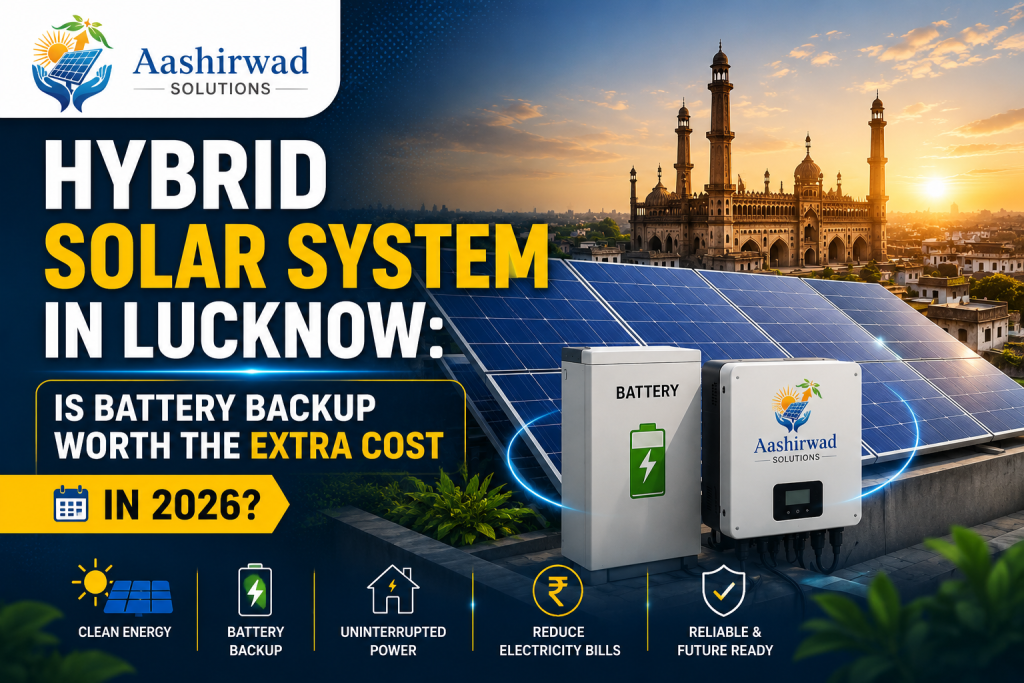
Every June, the same conversation plays out across Lucknow’s WhatsApp groups: the grid goes down for two hours right when the inverter battery is already running low, and somebody asks whether solar with a battery would have fixed it. That question is really about one specific product, a hybrid solar system and it deserves a clearer answer than “yes, get it.” A hybrid solar system solves a real problem, but it costs more than a plain on-grid setup, it comes with subsidy conditions people often get wrong, and it is not automatically the right solar power system for every roof. Here is how to actually decide.
What Does a Hybrid Solar System Do Differently?
A hybrid solar system connects your rooftop panels to both the electricity grid and a battery bank through a single hybrid inverter. During the day, it uses solar power for your home first, sends any surplus to the grid through your net meter, and tops up the battery. When the grid fails, the inverter switches over automatically and keeps essential circuits, lights, fans, a fridge, sometimes an AC which is running from stored battery power instead of leaving you waiting for the power cut to end.
That combination is what separates it from the other two options. An on-grid solar system has no battery at all; it lowers your bill through net metering but shuts down the moment the grid does, for safety reasons tied to how the inverter synchronises with grid voltage. For households with reliable electricity, an on-grid solar system can therefore be the simpler choice. An off-grid solar system runs entirely on batteries and never touches the grid, which means full independence but no net metering credit and a system sized to cover your entire daily load on its own, which is usually a bigger and costlier build. An off-grid solar system is more appropriate where dependable grid access is not available. A hybrid solar system sits between the two: grid savings on ordinary days, battery backup on bad ones. For many homes, this balance makes a hybrid solar system a practical middle ground.
Why This Question Is Coming Up More in Lucknow?
A few local realities are pushing hybrid into more conversations this year. Summer load on the grid is heavier than it used to be, with more homes running one or two ACs through May and June, and that additional draw shows up as short, unpredictable outages in several localities rather than scheduled cuts. Areas with older overhead infrastructure or heavier monsoon exposure tend to see this more than newer, well-planned colonies. At the same time, battery prices for lithium in particular have come down enough that hybrid is no longer priced only for large commercial buyers.
None of that means every household need backup power. It means the households that actually lose useful hours to outages have a real reason to look at hybrid, while households with a stable connection are usually better served putting the same budget into a larger on-grid system.
On-Grid vs Off-Grid vs Hybrid: The Practical Differences
| On-Grid | Off-Grid | Hybrid | |
| Runs during a power cut | No | Yes | Yes (backed-up circuits) |
| Net metering / bill credit | Yes | No | Yes, on the grid-tied portion |
| Battery required | No | Yes, sized for full load | Yes, sized for backup load |
| Upfront cost vs on-grid | Baseline | Higher | Higher (battery adds cost) |
| Best suited for | Stable grid connection | Remote / unreliable-grid sites | Frequent, short outages |
The cost gap between an on-grid solar system and a hybrid solar system comes almost entirely from the battery and the more capable hybrid inverter; the panels themselves can be similar. The final cost of a solar power system depends on its capacity, equipment and backup requirement. As a rough guide, adding battery backup typically pushes the system cost up by 40–70%, depending on battery chemistry and how many hours of backup you want.
Does a Hybrid System Qualify for the Subsidy?
This is the point buyers get wrong most often. Under PM Surya Ghar Muft Bijli Yojana, the central subsidy can be up to ₹78,000 and is available to grid-connected systems, and that includes hybrid systems, provided the hybrid inverter is ALMM-listed and the system is commissioned in grid-tie mode with a working net meter. What is not subsidised is the battery itself and the battery cabinet; the subsidy applies only to the solar panel and inverter portion of the system. Uttar Pradesh also runs a state top-up through UPNEDA on top of the central amount for eligible residential systems, though this is capped and subject to the DISCOM’s current rules at the time you apply. Pure off-grid systems, with no grid connection at all, do not qualify for the central subsidy.
Because DISCOM interpretation of hybrid configurations can vary and rules are updated periodically, it’s worth confirming current eligibility for your exact system size and battery configuration before you commit to a quote, rather than assuming the full subsidy applies automatically.
Battery Type and Backup Sizing
The backup you actually get during an outage depends far more on battery sizing than on the size of your solar array. A 3–5 kWh battery bank is generally enough to run lights, fans, WiFi and a refrigerator for several hours, the kind of backup most homes want for a two-hour evening cut. Proper solar power system sizing should still be based on the actual appliances and backup duration required. Running a bedroom AC through an outage needs a meaningfully larger battery bank, closer to 8–12 kWh, because ACs draw far more power than the rest of a household’s essential circuits combined.
On chemistry, lithium batteries cost more upfront but last longer, tolerate Lucknow’s summer heat better, and need less maintenance than tubular lead-acid batteries. The battery choice should be considered alongside the hybrid solar system design and expected backup load. Over a 10-year ownership period, lithium usually works out cheaper despite the higher initial price, though tubular remains a reasonable choice for buyers who want to keep the upfront cost down and are comfortable budgeting for a battery replacement partway through the system’s life.
Where Hybrid Actually Makes Sense and Where It Doesn’t?
A hybrid solar system is worth the extra cost when outages genuinely cost you something: a shop that loses billing and refrigeration during a cut, a home office that needs the WiFi router and a laptop to stay up, a household with a family member who depends on a medical device, or a locality that regularly sees unscheduled cuts through summer. In these cases, the backup pays for itself in avoided disruption even before you count the electricity bill savings.
A hybrid solar system makes less sense when your area has a genuinely stable supply and outages are rare. In that situation, the money that would go into a battery is usually better spent on a larger on-grid system, which lowers your monthly bill by more per rupee spent than a smaller hybrid system with a battery would. This is worth working out with actual numbers for your roof and consumption rather than deciding on backup power in the abstract.
How the Installation Actually Works?
A professional solar inverter installation for a hybrid solar system follows the same core sequence as any rooftop solar project, with two extra steps built in for the battery and backup wiring. It starts with understanding your electricity consumption and which specific loads you want backed up; this is what determines battery sizing, not guesswork. A proper solar inverter installation also needs the inverter and backup circuits to match the selected solar power system. A site visit follows to check roof space, shading, structural condition and the best mounting layout. From there, the system is designed around your sanctioned load and chosen backup scope, the hybrid inverter and battery are installed alongside the panels, and backed-up circuits are wired separately from the rest of the household so the inverter can isolate them during a grid failure. Net metering is then applied for through your DISCOM, and the solar power system is commissioned and tested, including a simulated outage before handover.
Aashirwad Solutions runs hybrid solar panel installations in Lucknow through this same process, alongside its on-grid solar system and off-grid solar system installation services, so the choice between the three is made against your actual roof and consumption data rather than a generic recommendation. The team also handles the rooftop assessment and installation work and ongoing panel cleaning that keeps any of these three system types performing at the output they were designed for.
Mistakes to Avoid When Choosing a Hybrid System
- Assuming the subsidy covers the whole system, including the battery, when it does not.
- Choosing battery capacity based on budget rather than which specific circuits actually need backup.
- Skipping the ALMM-listing check on the hybrid inverter, which can affect subsidy eligibility.
- Not confirming net metering approval with the DISCOM before installation is scheduled.
- Treating the inverter warranty and the battery warranty as the same thing, they usually aren’t, and battery warranties vary a lot by chemistry and brand.
- Oversizing the battery “to be safe,” which adds cost without adding proportional value if outages in your area are genuinely short.
Making the Call
A hybrid solar system is the right answer when backup power solves a problem you actually have, not because it sounds like the more complete option. Start with your electricity bill, an honest count of how many hours you lose to outages in a typical month, and which specific appliances matter during that time. That gives you a system sized to your situation rather than to a generic recommendation, whether that ends up being an on-grid solar system, an off-grid solar system, or a hybrid solar system.
If you’re weighing this decision for your own roof, Aashirwad Solutions offers a free site visit and consultation to compare an on-grid solar system with a hybrid solar system and work through the numbers for your specific electricity usage and locality before you commit to either. Contact the team to book a no-obligation assessment.
References
PM Surya Ghar: Muft Bijli Yojana – Ministry of New and Renewable Energy (MNRE) / Government of India- https://www.pmsuryaghar.gov.in/
PM Surya Ghar Muft Bijli Yojana, scheme overview and 2026 budget allocation – India Brand Equity Foundation (IBEF) – https://www.ibef.org/government-schemes/pm-surya-ghar-yojana
Hybrid Inverters Allowed Under PM Surya Ghar Scheme: MNRE – Saur Energy International, reporting an MNRE operational-guideline clarification – https://www.saurenergy.com/solar-energy-news/hybrid-inverters-allowed-under-pm-surya-ghar-scheme-mnre
UPNEDA Solar Rooftop Portal, state subsidy and net metering applications – Uttar Pradesh New and Renewable Energy Development Agency (UPNEDA) – https://upnedasolarrooftopportal.com/
Solar Subsidy in UP 2026: Eligibility & Benefits (state top-up structure) – Bharat Solar Shakti – https://www.bharatsolarshakti.com/blog/solar-subsidy-up/