Rooftop solar is becoming a common sight across Lucknow, from independent homes in Gomti Nagar to shops in Alambagh and Chinhat. Rising electricity bills and growing awareness of clean energy are pushing more homeowners to consider a rooftop solar system. But solar safety deserves just as much attention as savings and payback period. A solar system is, at its core, an electrical installation exposed to sun, rain, dust, and Lucknow’s summer heat. When it is properly designed, installed and maintained, a solar system can provide reliable electricity for many years. When shortcuts are taken, on the roof survey, the wiring, or the component quality then the result can be anything from underperformance to a genuine electrical hazard. This article walks through seven mistakes homeowners commonly encounter during rooftop solar installation, so you know what to check for and what to ask your installer, whether you’re working with Aashirwad Solutions or comparing quotes from multiple companies.
Why Solar Safety Matters Before You Install Rooftop Solar
A rooftop solar system combines two things that both require careful handling: an electrical circuit and a permanent rooftop structure. The panels, wiring, and inverter sit outdoors year-round, exposed to heat, monsoon moisture, dust, and during storms the lightning-related electrical surges. None of this makes solar inherently risky, but it does mean the installation has to be planned with these conditions in mind, not treated as a simple box-fitting job.
Correct system design and installation practice reduce avoidable problems: loose connections that heat up over time, cables that degrade under UV exposure, or mounting structures that aren’t matched to the roof they sit on. Most of these issues are preventable at the planning and installation stage rather than fixed later. That’s why a proper site assessment, quality components, and careful workmanship matter as much as the brand of panel you choose.
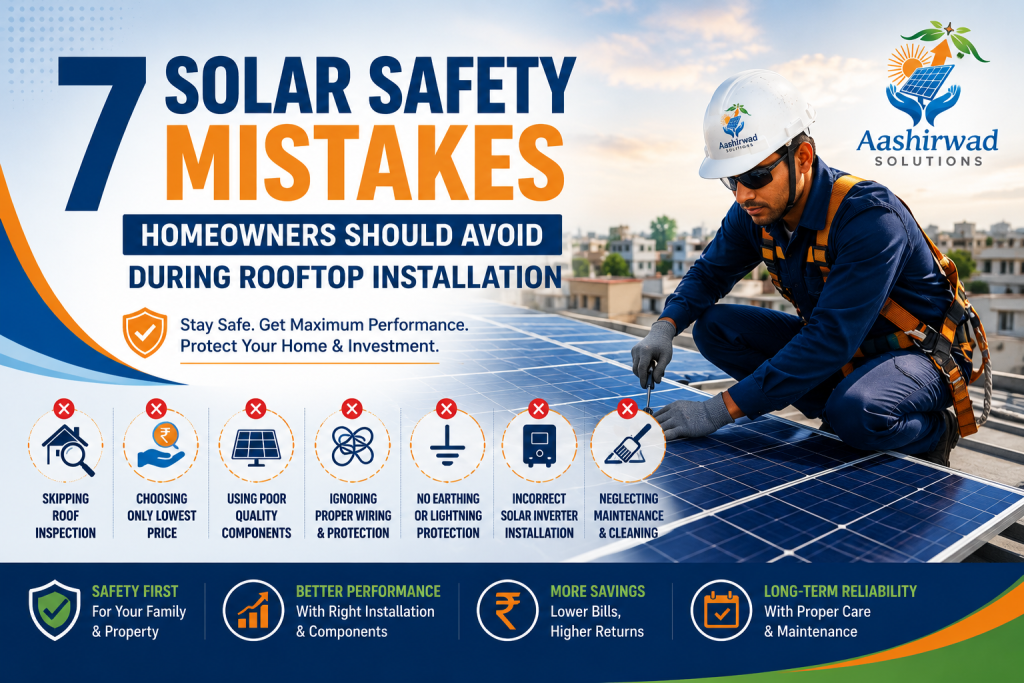
Solar Safety Mistake #1: Skipping a Proper Roof Inspection
It’s tempting to jump straight from “I want solar” to “install it this week,” but the roof itself needs a proper look first. A qualified installer should assess the roof’s structural condition and age, the available clear space, shading from trees or neighbouring buildings, panel orientation for maximum sunlight, and any existing rooftop structures like water tanks, cooling towers, or water-proofing membranes that could interfere with panel placement or maintenance access.
This assessment also determines the right mounting approach for your specific roof, whether that’s a flat RCC roof, a sloped tiled roof, or a roof shared with other utilities. Before signing on with any installer, ask specifically how they assess your roof, what they check for shading and structural load, and how they plan access for future maintenance. Aashirwad Solutions’ rooftop solar panel installation process for Lucknow properties begins with a free site inspection where the team evaluates rooftop space, shading, and daily sunlight exposure before recommending a system, which is the standard a homeowner should expect from any credible rooftop solar installation.
Solar Safety Mistake #2: Choosing an Installer Based Only on the Lowest Price
Price comparisons are natural when you’re getting multiple quotes, but the cheapest number on paper doesn’t always reflect the same scope of work. A low-priced quote isn’t automatically unsafe but it’s worth checking exactly what’s included before assuming two quotes are comparable.
When comparing installers, look at the complete picture: panel and inverter brand and specification, mounting structure quality, the extent of wiring and protection equipment included, whether earthing is part of the scope, labour and installation standards, testing and commissioning before handover, net-metering documentation support, and what warranty and after-sales support is actually offered.
Two quotes that look similar on total price can differ significantly once you compare what each installer includes for protection equipment and testing. This is really what professional solar installation means in practice, not just fitting panels, but covering design, component selection, safe wiring, and verified commissioning as one connected process, with subsidy paperwork and net metering approvals handled as part of the service rather than left to the homeowner.
Solar Safety Mistake #3: Using Poor-Quality Panels or Electrical Components
Every component in a solar system plays a role in safety, not just performance. This includes the panels themselves, but also the cables, connectors, junction boxes, protection devices, mounting hardware, and inverter internals. Lower-grade components can degrade faster under Lucknow’s heat and dust, and connectors that aren’t rated correctly for outdoor use are more prone to loosening or moisture ingress over time.
This doesn’t mean every budget component is unsafe or that every premium brand guarantees a perfect installation, component quality is one factor among several, and it works alongside correct installation practice. What matters is that panels, inverters, and supporting hardware are sourced from established manufacturers with proper certification, rather than unbranded stock chosen purely to cut cost. Ask your installer which manufacturers they use and why, and don’t be afraid to ask for datasheets on the cables and protection devices, not just the panels.
Solar Safety Mistake #4: Ignoring Proper Wiring, Earthing and Cable Management
Wiring is one of the least visible parts of a solar installation, and that’s exactly why it’s often where corners get cut. Good practice includes routing DC and AC cables so they’re protected from mechanical damage, using proper clips and conduit rather than leaving cables lose on the roof, and choosing cable insulation rated for outdoor UV and heat exposure.
It’s worth being precise here rather than repeating oversimplified advice. Not every cable in a solar system needs to be “grounded”, that phrase gets used loosely and isn’t technically accurate. What a compliant installation actually needs is a distinction between equipment earthing (connecting the metal frames of panels, mounting structures, and the inverter body to an earth electrode so they can’t become electrically live if a fault occurs), structural bonding (electrically connecting metal components together), and general cable protection and routing (which is about mechanical and weather protection, not earthing).
For earthing, Indian electrical installations can be designed with reference to applicable Bureau of Indian Standards guidance, including IS 3043, alongside the Central Electricity Authority’s applicable safety regulations. A homeowner doesn’t need to memorise these standards, but it’s reasonable to ask your installer to confirm that equipment earthing has been done and tested, separately from asking about general wiring and mounting structure quality, That’s where our guide to solar panel mounting structures covers how the frame and earthing points typically fit together on a rooftop system.
Solar Safety Mistake #5: Treating Solar Inverter Installation as an Afterthought
The inverter is the component that converts the DC electricity generated by your panels into the AC electricity your home actually uses, and it’s often the part of the system that gets the least attention during planning. Where and how it’s installed affects both performance and safety.
Inverter placement should account for ventilation and heat dissipation, since inverters generate heat during operation and performance can be affected if airflow is restricted. Location matters too as it provides protection from direct rain and excess moisture, along with accessibility for routine checks and eventual servicing, are all part of a proper inverter installation rather than an afterthought. Correct sizing relative to your panel capacity and electrical load, along with properly rated AC and DC connections and appropriate protection devices, are equally important. This is precisely why solar inverter installation is called out separately from the rest of the electrical work: a skilled team, like Aashirwad Solutions’ technicians who handle inverter setup as a distinct step in their testing and activation process before system handover, treats inverter placement and commissioning as its own checklist rather than something bundled in at the end of a long installation day.
Solar Safety Mistake #6: Ignoring Lightning and Surge Protection
A rooftop is, by definition, one of the more exposed points on a building, which means the electrical equipment on it is more susceptible to voltage surges, whether from a nearby lightning strike or fluctuations on the grid itself. This is a genuine consideration for rooftop solar, though it’s worth being accurate rather than alarmist about it: not every rooftop system is at equal risk, and the right protection measures depend on your building’s location, height, and existing lightning protection arrangement, if any.
Appropriately selected surge protective devices on the relevant AC and DC circuits can help limit transient overvoltage and reduce the risk of damage to sensitive equipment such as the inverter. Equipment earthing, discussed above, works alongside surge protection rather than replacing it, the two serve different but related purposes. A properly designed rooftop solar system should account for lightning and surge protection as part of its overall electrical protection scheme, rather than treating it as an optional add-on. If your property already has lightning protection installed for the building, tell your solar installer so the existing protection can be considered when designing the solar system.
Solar Safety Mistake #7: Failing to Plan for Inspection, Maintenance and Future Safety
Solar safety doesn’t end at commissioning. Rooftop systems benefit from periodic inspection which includes checking cable connections for looseness, inspecting the mounting structure for corrosion or movement, monitoring inverter performance, and cleaning panels so dust build-up doesn’t reduce output. How often cleaning is needed varies with local dust levels and weather, and it’s worth asking your installer what schedule they’d recommend for your specific property rather than assuming a fixed interval applies to every system.
Planning for maintenance access at the design stage, leaving clear walking space around panels, for instance then makes this ongoing upkeep considerably easier and safer than trying to retrofit access later. Aashirwad Solutions offers residential, commercial, and industrial solar panel cleaning across Lucknow, along with inspection and preventive maintenance support, which reflects the kind of after-sales relationship worth looking for, one that doesn’t end the day the panels are switched on.
Making Solar Safety Part of Your Installation Plan
Across these seven points, a pattern emerges: solar safety isn’t one single decision, it’s a sequence of site assessment, system design, component selection, installation quality, electrical protection, testing, and ongoing maintenance. Weakness at any single stage can undermine the rest, which is why it’s worth evaluating an installer on the full process rather than any one factor in isolation.
If you’re planning rooftop solar installation in Lucknow, whether in Gomti Nagar, Chinhat, Rajajipuram, or elsewhere in the city then it’s worth asking prospective installers directly about each of these seven points before you sign anything. Aashirwad Solutions works through this same sequence for residential and commercial properties across Lucknow, from the initial site visit through to net metering support and subsidy paperwork under schemes like PM Surya Ghar. If you’d like your property assessed and your questions answered directly, Aashirwad Solutions can walk you through what a properly planned, safely installed rooftop system looks like for your specific roof and energy needs.